---
title: I've Spent 20+ Years Becoming Good at the Law. Why Do I Now Have To Prove Myself Online?
description: How to turn decades of judgment into a clear, ethical visibility system so the right clients can find you, understand you, trust you, and take the next step with confidence.
image: https://ethosleads.com/hubfs/LinkedIn%20Article_2026-3-May-07-2026-10-58-05-2883-AM.png
---
[Skip to content](https://ethosleads.com/resources/ive-spent-20-years-becoming-good-at-the-law.-why-do-i-now-have-to-prove-myself-online#main-content)
This is a search field with an auto-suggest feature attached.
- There are no suggestions because the search field is empty.
[](https://ethosleads.com/)
- [Services](https://ethosleads.com/services)
- [Foundation Marketing System](https://ethosleads.com/foundation-for-solo-small-law-firms)
- [Fractional CMO](https://ethosleads.com/services/fractional-cmo-for-law-firms)
- [Immigration Firm Visibility Audit](https://ethosleads.com/immigration-law-firm-visibility-audit-netherlands)
- [Law Firm Visibility Gap Self-Audit](https://ethosleads.com/law-firm-marketing-system-audit)
- [Outcomes](https://ethosleads.com/outcomes)
- [Resources](https://ethosleads.com/resources)
- [Blogs](https://ethosleads.com/resources)
- [Course for Lawyers](https://ethosleads.com/law-firm-growth-marketing)
- [Business Goal Setting Worksheet](https://ethosleads.com/business-goals-setting-worksheet)
- [Marketing Budget Calculator](https://ethosleads.com/marketing-budget-calculator-for-law-firms)
- [Ad Budget Calculator](https://ethosleads.com/ad-budget-calculator-for-law-firms)
- [Free Lawyer Video Power Book](https://ethosleads.com/lawyer-video-power-book)
- [About](https://ethosleads.com/about)
- [Grow My Firm](https://ethosleads.com/contact)
- Search Search
Search
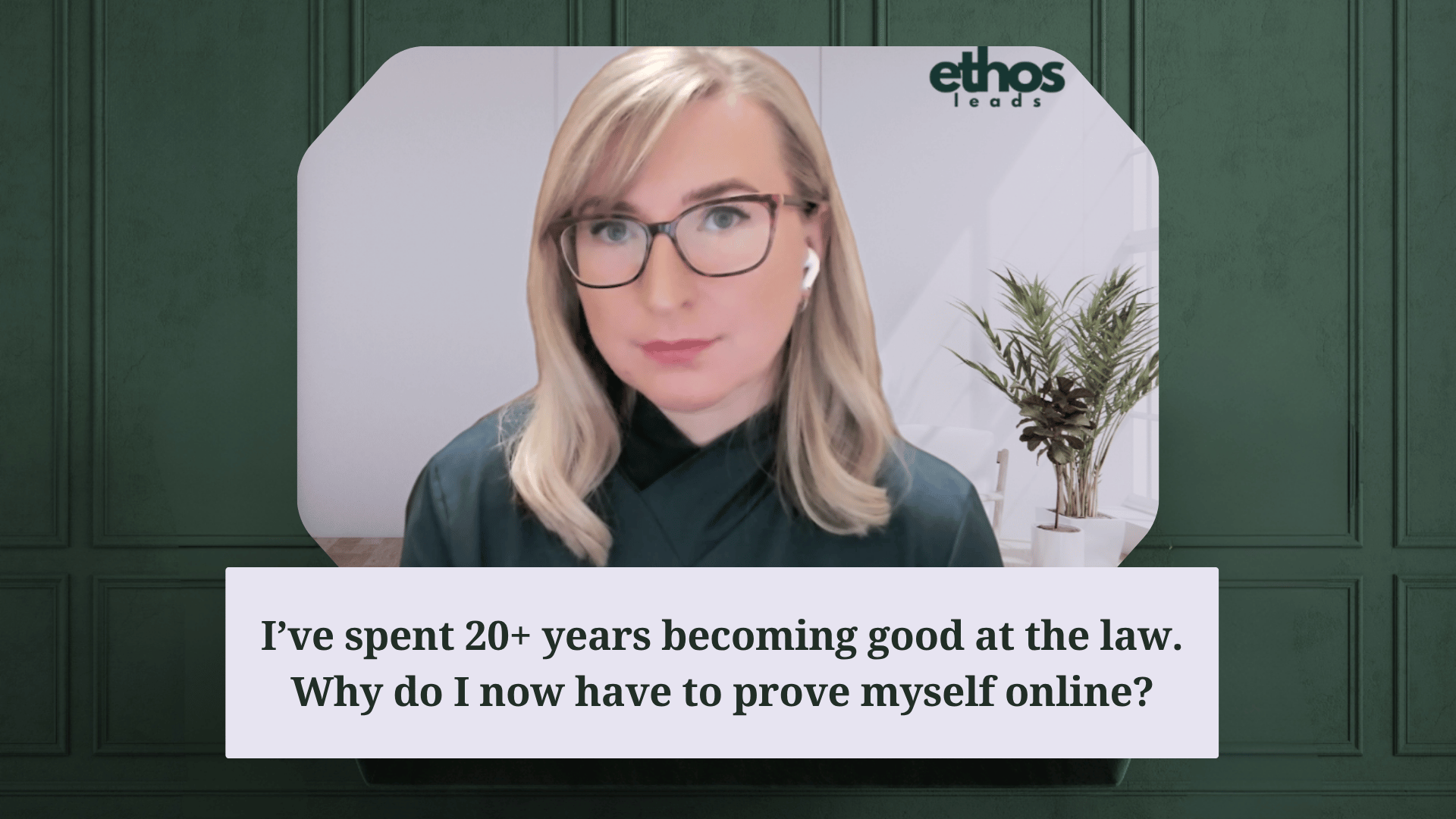
# I've Spent 20+ Years Becoming Good at the Law. Why Do I Now Have To Prove Myself Online?

[Olha Bodnar May 7, 2026](https://ethosleads.com/resources/author/olha-bodnar)
- [Strategy](https://ethosleads.com/resources/tag/strategy)
- 7 mins
## The Rules You Were Trained Under Have Stopped Being Sufficient On Their Own
There is a specific sentence experienced lawyers think and almost never say out loud.
It tends to surface somewhere between the third and the tenth time you have Googled yourself this year. Maybe after a referred client did not call back. Maybe after watching a lawyer with a fraction of your experience confidently explain the same area of law on a video that has six thousand views. Maybe at the end of a quarter where the inquiries felt thinner than they should have, for reasons no one could quite name.
The sentence is some version of this:
*"I've have spent more than two decades becoming genuinely good at this. Why does the market suddenly need me to perform?"*
If that sentence has crossed your mind, you are responding sanely to a change in the market, and most of the people writing about that change are talking past you.
This piece will not. It assumes you are excellent at law. It assumes you do not need to be told to "get on LinkedIn," "start posting daily," or build a personal brand. And it assumes you have very specific reasons for finding most legal marketing slightly embarrassing, reasons that are correct.
## The rules you were trained under have stopped being sufficient on their own.
You were trained in a market where reputation traveled. Good work produced referrals. Referrals produced more referrals. Bar relationships, courtroom credibility, and the slow accumulation of being the lawyer people recommended to their friends. That was the system. It worked, for a long time, and it worked well enough that an entire generation of excellent lawyers built durable practices on it without ever needing to think about marketing.
That system has not vanished. It has just lost its monopoly.
Today, even the clients who arrive through a strong referral validate you online before they pick up the phone. They Google you, scroll your website, check your LinkedIn. They form an impression of who you are in roughly the time it takes to read three sentences, and that impression decides whether the referral converts or not.
Most experienced lawyers do not see this happening, because the people who cool off do not write back to explain why. They simply choose someone else, and the lawyer who lost the matter never learns that they had been almost chosen.
If you are feeling some version of the sentence at the top of this piece, you are probably also feeling one or more of the following:
More price-shoppers. More people who do not understand what your level of work actually involves. Fewer of the matters that used to make you feel like the practice was running well.
A growing distance between your real reputation and your online presence. You know what former clients and referring colleagues say about you. Your website does not say it. Your LinkedIn profile does not say it. Your Google Business Profile does not say it.
A specific kind of irritation when you see a less qualified competitor become more visible. You know what it took you twenty years to learn. You can see, in three minutes of their content, that they have not learned it yet. And the market does not appear to notice.
And underneath all of it, a fatigue from the feeling that something is off, that the system is no longer doing what it used to do, and that you have not had the time to figure out what to do about it.
## Your training is, paradoxically, working against you
There is a specific reason experienced lawyers struggle to make their expertise visible online, and it has nothing to do with intelligence, technology, or effort.
It is that you know too much.
The five-year lawyer who posts a short video saying "Here are the three things people get wrong about X" sounds clear and trustworthy to a prospective client. You know that there are not three things. There are seventeen, the answer depends, and the framing is a little misleading. You are right. You are also invisible.
The market is not punishing your judgment. It is just unable to perceive it through the lens you were trained to use. That is not a failure on your part. That is a translation problem. And translation problems have solutions that do not require you to dumb anything down.
## And no, the answer is not to become one of the lawyers you would not refer your own family to.
Let me name something directly, because most marketing people will not.
A great deal of legal marketing is genuinely beneath the profession. The aggressive billboard energy. The hooks that promise outcomes no serious lawyer would promise. The vaguely manipulative copy. The content that confuses confidence for competence. You see it every day, and your reaction to it is correct.
If the choice were between staying invisible and becoming that, staying invisible would be the right call. Your reputation took twenty years to build. Trading dignity for clicks would be a bad trade at any price.
But that has never actually been the choice. It has just been presented that way, often by marketers who do not understand the difference between attention and trust, and almost never by anyone who understands legal ethics or the way clients actually decide.
There is a third option. It is the one this entire piece exists to point you toward.
## You are being asked to be properly findable
This is the reframe that, in my experience, lands hardest with experienced lawyers, because it gives a name to something they have been feeling but could not quite articulate.
The modern client validating you online is looking for enough signal to feel safe taking the next step.
They want to feel that the lawyer they are about to call has handled their kind of problem before, thinks clearly about the issues that matter to them, is current and seriously practicing, and is the kind of person they could speak to without being condescended to.
Your job is not to perform competence. Your competence is settled. Your job is to make sure that when a serious prospective client looks for you, what they find accurately reflects the lawyer you have already become.
That is a fundamentally different ask than 'start marketing yourself.' It is about closing the gap between the lawyer you are and the lawyer the market is currently able to perceive.
## There is a longer-term version of this conversation that almost no one raises with you
Most of what gets written about legal marketing treats it as a short-term lead-generation problem. For an experienced lawyer, that framing misses the deeper stakes.
Twenty years of judgment is a serious asset. It is also, at the moment, almost entirely undocumented. It lives in your head. It lives in the half-conversations you have had with clients, opposing counsel, and younger lawyers in your firm. It lives in the cases you remember and the patterns you can now see at a glance.
The day you slow down, retire, or transition the firm, that asset largely evaporates unless something has been built around it.
Visibility, done seriously, is also archival. It captures your judgment in a form that outlives any single matter. It builds firm value rather than personal exhaustion. It gives a successor, an associate, or a buyer something to point at when they describe what your practice actually stands for. And it gives the version of you who eventually steps back from the day-to-day a quiet sense that the work was understood, named, and recognized.
That is a different reason to take this seriously than 'more leads.' For most lawyers in this category, it is also the truer one.
## The real problem is the visibility gap
There is a specific name for what is doing the damage in your practice right now.
It is the gap between the reputation you have already earned offline and what a prospective client can perceive about you online. It is the distance between the lawyer your colleagues describe in private and the lawyer your website describes in public. It is the space between what your former clients believe and what your future clients can currently see.
It is the reason a referred client cools off after looking you up. It is the reason a matter you should have won goes to a competitor you know is less qualified. It is the reason your inquiries have drifted toward people who do not understand your value.
None of that means you have fallen behind as a lawyer. It means your visibility has not kept pace with the lawyer you have become. Those are very different problems, and only one of them is fixable from the outside.
## What a serious solution actually looks like
A real answer to the visibility gap is not more content. It is not louder marketing. It is not a personal brand. It is not a campaign to make you famous, and it is certainly not another vendor selling you posts.
It is a system, designed for the way experienced lawyers actually think, that does five things in coordination.
It clarifies your positioning, so that the right kind of client immediately recognizes that you are a fit, and the wrong kind of client quietly self-selects out before they ever land on your calendar.
It rebuilds the trust pathway across your website, your Google Business Profile, your LinkedIn presence, and your search visibility, so that the impression a prospect forms in the first three sentences accurately reflects the lawyer you are.
It captures your judgment, in your voice, in formats that respect both your time and the bar rules you have spent a career honoring. Nothing performative. Nothing that would embarrass you in front of a colleague.
It runs in the background, with you approving rather than producing, so that your week is not consumed by becoming a content creator. Roughly an hour a month of your time. The rest is handled.
And it reports back to you in plain language, so you can see whether your visibility is improving and where it still has room to grow.
## The deepest version of what you want is recognition
If you sit with the sentence at the top of this piece long enough, you will notice that it is not really about marketing. It is not really about leads. It is not even really about competition.
It is about a wish that the outside world would finally see the level of expertise you know you have spent twenty years building. That serious clients would arrive already understanding why your judgment is worth paying for. That you would stop having to prove yourself, in small ways, to people who should already be able to tell.
That is a fair thing to want. It is also the most fixable problem in your practice right now.
Your reputation still matters. Your judgment still matters. Your experience still matters. The only thing that needs updating is the way those things are visible to the people who are, right now, this week, looking for a lawyer like you and almost finding someone else instead.
**The most qualified lawyer in the room should not lose because the market could not understand the difference.**
If you are ready to close that gap on your own terms, with a system that respects your standards and your time, that is exactly what we built Foundation to do.
**If this resonates, the next step is small.**
We start with [a visibility gap assessment](https://ethosleads.com/law-firm-marketing-system-audit): a structured look at where your current online presence is failing to communicate the lawyer you actually are, and what would change if it did.
---
### Learn more about the Foundation Marketing System
[Book a Strategy Call](https://ethosleads.com/foundation-for-solo-small-law-firms)

### Olha Bodnar
Olha Bodnar is the founder of Ethos Leads, a marketing partner for solo and small law firms in North America and Europe. She has worked in legal marketing for more than 12 years, including years with law firms in Canada and the US, and has built a business from zero in four countries. Her work focuses on the buyer psychology behind how clients choose a lawyer, and on compliance-first content that turns legal expertise into consultation requests.
[mailto:olha@ethosleads.com](mailto:olha@ethosleads.com)
## Latest Posts
- [ALL POSTS](https://ethosleads.com/resources/all)
[](https://ethosleads.com/resources/would-you-let-your-firms-marketing-go-pro-se)
[Strategy](https://ethosleads.com/resources/tag/strategy)
10/8/26, 6:23 AM
### [Would You Let Your Firm's Marketing Go Pro Se?](https://ethosleads.com/resources/would-you-let-your-firms-marketing-go-pro-se)
[](https://ethosleads.com/resources/how-ai-now-shortlists-lawyers)
[Strategy](https://ethosleads.com/resources/tag/strategy)
10/1/26, 7:13 AM
### [How AI Now Shortlists Lawyers](https://ethosleads.com/resources/how-ai-now-shortlists-lawyers)
[](https://ethosleads.com/)
## Your Growth. Our Ethics. One Marketing Partner.
### Serving solo and small firms across the U.S., Canada, and Europe.
Helping solo and small law firms in North America and Europe build compliant, trust-first marketing systems that generate steady, high-quality clients.
[View our services](https://ethosleads.com/services)
© 2026 Ethos Leads, LLC
[Follow us on LinkedIn](https://www.linkedin.com/in/olhabodnar/) [Follow us on Twitter](https://www.youtube.com/@ethosleads) [Follow us on Facebook](https://www.instagram.com/ethosleads/) [Follow us on Facebook](https://www.tiktok.com/@olha.bodnar.ethos) [Follow us on Facebook](mailto:olha@ethosleads.com)
```json
{
"@context" : "https://schema.org",
"@type" : "BlogPosting",
"author" : {
"@type" : "Person",
"name" : "Olha Bodnar",
"url" : "https://ethosleads.com/resources/author/olha-bodnar"
},
"dateModified" : "2026-05-07T11:20:11.886Z",
"datePublished" : "2026-05-07T11:20:11.000Z",
"headline" : "I've Spent 20+ Years Becoming Good at the Law. Why Do I Now Have To Prove Myself Online?",
"image" : [ "https://ethosleads.com/hubfs/LinkedIn%20Article_2026-3-May-07-2026-10-58-05-2883-AM.png" ],
"mainEntityOfPage" : {
"@id" : "https://ethosleads.com/resources/ive-spent-20-years-becoming-good-at-the-law.-why-do-i-now-have-to-prove-myself-online",
"@type" : "WebPage"
},
"publisher" : {
"@type" : "Organization",
"logo" : {
"@type" : "ImageObject",
"url" : "https://ethosleads.com/hubfs/Ethos%20Leads_logo_white_transparent.png"
}
}
}
```