---
title: From Marketing Activity to CEO-Level Growth. The Structure Most Law Firms Are Missing
description: There is another way to be visible, and experienced lawyers tend to recognize it the moment they see it, because it is built from the same signals they already trust inside their own profession.
image: https://ethosleads.com/hubfs/LinkedIn%20Article_2026-3-Jun-04-2026-01-38-21-9066-PM.png
---
[Skip to content](https://ethosleads.com/resources/from-marketing-activity-to-ceo-level-growth.-the-structure-most-law-firms-are-missing#main-content)
This is a search field with an auto-suggest feature attached.
- There are no suggestions because the search field is empty.
[](https://ethosleads.com/)
- [Services](https://ethosleads.com/services)
- [Foundation Marketing System](https://ethosleads.com/foundation-for-solo-small-law-firms)
- [Fractional CMO](https://ethosleads.com/services/fractional-cmo-for-law-firms)
- [Immigration Firm Visibility Audit](https://ethosleads.com/immigration-law-firm-visibility-audit-netherlands)
- [Law Firm Visibility Gap Self-Audit](https://ethosleads.com/law-firm-marketing-system-audit)
- [Outcomes](https://ethosleads.com/outcomes)
- [Resources](https://ethosleads.com/resources)
- [Blogs](https://ethosleads.com/resources)
- [Course for Lawyers](https://ethosleads.com/law-firm-growth-marketing)
- [Business Goal Setting Worksheet](https://ethosleads.com/business-goals-setting-worksheet)
- [Marketing Budget Calculator](https://ethosleads.com/marketing-budget-calculator-for-law-firms)
- [Ad Budget Calculator](https://ethosleads.com/ad-budget-calculator-for-law-firms)
- [Free Lawyer Video Power Book](https://ethosleads.com/lawyer-video-power-book)
- [About](https://ethosleads.com/about)
- [Grow My Firm](https://ethosleads.com/contact)
- Search Search
Search
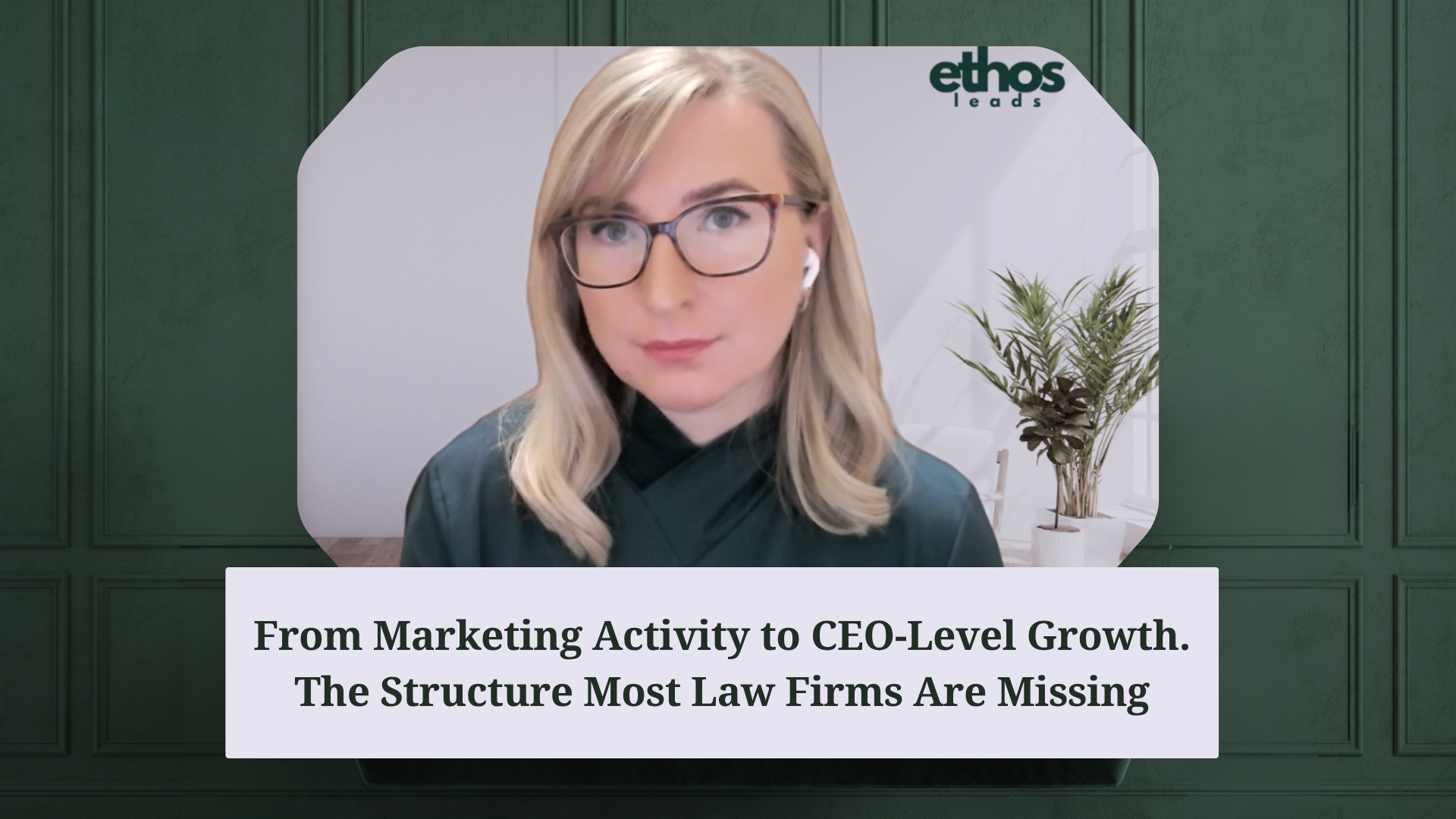
# From Marketing Activity to CEO-Level Growth. The Structure Most Law Firms Are Missing

[Olha Bodnar June 4, 2026](https://ethosleads.com/resources/author/olha-bodnar)
- [Strategy](https://ethosleads.com/resources/tag/strategy)
- 5 mins
## Your current situation
You have a Google Ads account generating 65% of your revenue. You have a team of contractors handling content, social media, and your newsletter. You run monthly webinars. You track every case by source and know your numbers.
And you are still billing one case a month.
The firm you have described to yourself (three to five associate lawyers, you setting direction, work-life balance, etc.) is a real thing. Other lawyers have built it. The distance between your current model and that firm is a question of whether the system you have built is capable of producing that outcome.
*Right now, it is not.*
### Your current situation
There is a specific pattern that shows up in legal practices at your revenue level. It looks like this:
Paid traffic covers the gap. Google Ads is expensive and unpredictable, but it works well enough that cutting it feels dangerous. Two-thirds of revenue flows through a channel you do not control and cannot scale by improving your legal work.
The content team is active, but not strategic. A contractor posts articles. Another sends the newsletter. A third handles distribution. They know each other and they do their jobs. What they cannot do is answer the question you keep asking: are we getting closer to where we want to be? They post because that is what they were hired to do.
You are still the strategic layer. You review what goes out. You course correct. You push the team when the metrics decrease. You are spending a third of your time managing a marketing function that is supposed to make you less involved, not more.
This is exactly where a firm lands when the owner is smart, operationally capable, and building things in the right direction but without a system that can run past the owner.
### The gap is not where you think it is
You have correctly identified that referral partners. You understand the referral psychology.
What the content you have right now does not yet do is build that trust systematically.
Your newsletter covers real estate law cases. That is useful information. It earns some attention. But information alone does not move another lawyer from ‘aware of you’ to ‘confident enough to attach their name to a referral.’ That move requires trust, and trust in this market is built differently from how useful content builds it.
Referral partners need to understand your judgment. They need to believe that putting a client in your hands reflects well on them. Before they can feel that, they need to see how you think, not just what you know. There is a difference between a newsletter that reports on cases and content that reveals how an experienced litigator would read a situation. The first one is informative. The second one builds professional trust.
Right now, the trust-building is happening by accident when it happens at all. One colleague saw you on LinkedIn and remembered you do litigation. One lawyer found your YouTube channel without any promotion behind it. One client came through Meta. These are signals that the underlying direction is right. They are also signals that the system is not yet doing the work.
### What the CEO version of this law firm requires
You want to be hands off. You had a version of that when your practice was busy. You took three weeks of vacation and worked one or two hours a day. That was real. The reason it worked was that the work was coming in with enough consistency that your team could handle the volume without your constant input at the intake end.
The business-owner version of your practice requires that same condition in the marketing function: consistent enough flow that you are approving things, not driving them.
### That does not exist yet. Here is why.
Paid traffic keeps the firm alive, but it cannot build the leverage you need. Every dollar you spend on Google Ads produces a case at a rate that requires your personal attention to close. The ratio is fine at your current revenue. At double the revenue, with an associate, you need the cost per case to come down and the quality of the intake to go up. Paid search at five thousand dollars a month cannot produce that shift by itself.
Disconnected content produces activity without accumulation. Your articles are high quality. Your webinars are well-attended. But they are not building toward anything that compounds. Each webinar is its own effort. Each newsletter issue is its own event. There is no architecture underneath it that turns a lawyer who attended three webinars into someone who thinks of you first when an issue lands on their desk.
And the oversight requirement is the most expensive cost you are carrying. You are a lawyer who is spending a meaningful portion of your week asking whether the team is going in the right direction. Every hour you spend on that question is an hour you are not spending on the work that would let you justify hiring. It is also the hour you cannot get back if a good file requires your full attention.
You have been trying to grow your way to the CEO model by doing more marketing. The model you want requires a different structure, not more of the same structure.
## The structural difference
A visibility system that produces the business you want does three things your current model does not.
1. It positions your judgment, not just your service area. Content that helps a real estate lawyer understand how you read a title dispute (what you notice that others miss, where the exposure typically lies) does more trust-building work than a newsletter recap of case outcomes. The referral partner needs to believe in your thinking before they will stake their own relationship on a referral. That takes content that reveals professional judgment, not just professional knowledge.
2. It accumulates. Each piece of content should be part of a sequence that moves a prospective referral partner from awareness through familiarity to trust. A webinar that stands alone is a good event. A webinar whose recording lives on a gated page, whose key argument becomes a blog post, whose insight becomes a short video clip, that is an asset. It keeps working after you stop thinking about it.
3. It runs without you managing it. This is the part that cannot be achieved with a team of contractors who need you to hold the strategy. It requires someone whose job is the strategy, not the execution alone. When you are the strategic layer, you are still the CEO of marketing. That is not the same as being the CEO of a law firm.
The question is: *does the structure you have built produce the business you want, or does it just keep the lights on while you wait?*
---
Visibility Gap Assessment
*If you want to see where your current online presence is doing the trust work for you and where it isn't, start with [a visibility gap assessment](https://ethosleads.com/law-firm-marketing-system-audit). It is a structured diagnostic built to identify what is already working before recommending what to change.*
---
### Learn more about the Foundation Marketing System
[Book a Strategy Call](https://ethosleads.com/foundation-for-solo-small-law-firms)

### Olha Bodnar
Olha Bodnar is the founder of Ethos Leads, a marketing partner for solo and small law firms in North America and Europe. She has worked in legal marketing for more than 12 years, including years with law firms in Canada and the US, and has built a business from zero in four countries. Her work focuses on the buyer psychology behind how clients choose a lawyer, and on compliance-first content that turns legal expertise into consultation requests.
[mailto:olha@ethosleads.com](mailto:olha@ethosleads.com)
## Latest Posts
- [ALL POSTS](https://ethosleads.com/resources/all)
[](https://ethosleads.com/resources/would-you-let-your-firms-marketing-go-pro-se)
[Strategy](https://ethosleads.com/resources/tag/strategy)
10/8/26, 6:23 AM
### [Would You Let Your Firm's Marketing Go Pro Se?](https://ethosleads.com/resources/would-you-let-your-firms-marketing-go-pro-se)
[](https://ethosleads.com/resources/how-ai-now-shortlists-lawyers)
[Strategy](https://ethosleads.com/resources/tag/strategy)
10/1/26, 7:13 AM
### [How AI Now Shortlists Lawyers](https://ethosleads.com/resources/how-ai-now-shortlists-lawyers)
[](https://ethosleads.com/)
## Your Growth. Our Ethics. One Marketing Partner.
### Serving solo and small firms across the U.S., Canada, and Europe.
Helping solo and small law firms in North America and Europe build compliant, trust-first marketing systems that generate steady, high-quality clients.
[View our services](https://ethosleads.com/services)
© 2026 Ethos Leads, LLC
[Follow us on LinkedIn](https://www.linkedin.com/in/olhabodnar/) [Follow us on Twitter](https://www.youtube.com/@ethosleads) [Follow us on Facebook](https://www.instagram.com/ethosleads/) [Follow us on Facebook](https://www.tiktok.com/@olha.bodnar.ethos) [Follow us on Facebook](mailto:olha@ethosleads.com)
```json
{
"@context" : "https://schema.org",
"@type" : "BlogPosting",
"author" : {
"@type" : "Person",
"name" : "Olha Bodnar",
"url" : "https://ethosleads.com/resources/author/olha-bodnar"
},
"dateModified" : "2026-06-06T17:45:19.690Z",
"datePublished" : "2026-06-04T13:42:25.000Z",
"headline" : "From Marketing Activity to CEO-Level Growth. The Structure Most Law Firms Are Missing",
"image" : [ "https://ethosleads.com/hubfs/LinkedIn%20Article_2026-3-Jun-04-2026-01-38-21-9066-PM.png" ],
"mainEntityOfPage" : {
"@id" : "https://ethosleads.com/resources/from-marketing-activity-to-ceo-level-growth.-the-structure-most-law-firms-are-missing",
"@type" : "WebPage"
},
"publisher" : {
"@type" : "Organization",
"logo" : {
"@type" : "ImageObject",
"url" : "https://ethosleads.com/hubfs/Ethos%20Leads_logo_white_transparent.png"
}
}
}
```